
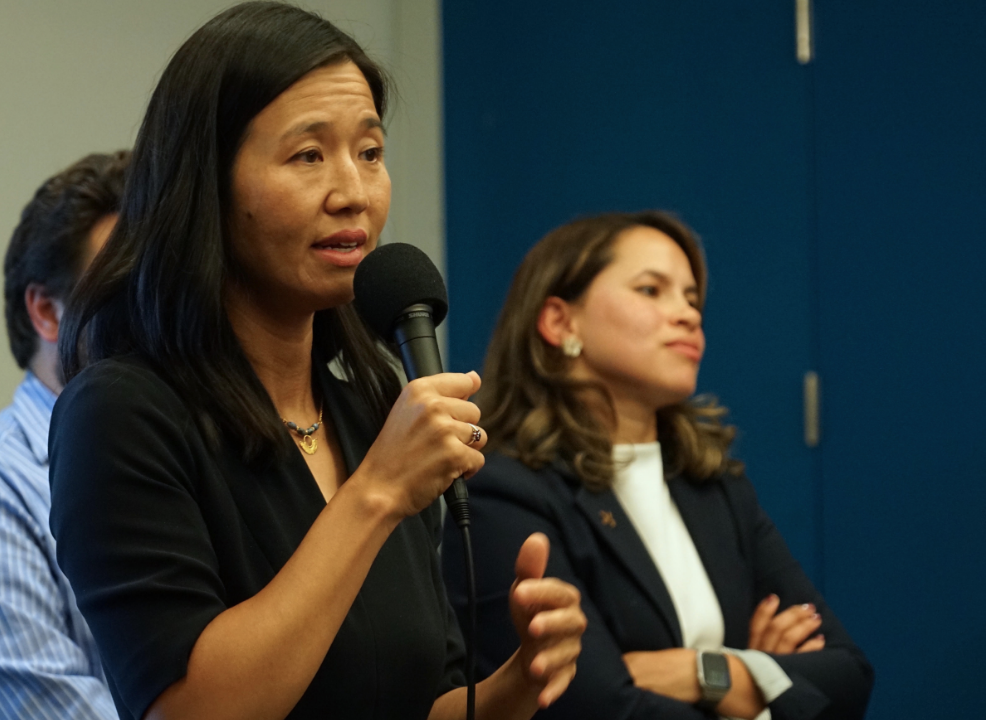
When Mayor Michelle Wu and challenger Josh Kraft went head-to-head over housing policy on July 15 at the Reggie Lewis Center in Roxbury, it was clear early on who enjoyed the home court advantage.
The two candidates sat before an estimated 850 people at a rally and forum organized by the Dorchester-based Massachusetts Affordable Homeownership Alliance (MAHA), in what turned out to be a sweltering gymnasium—after late notice of an air conditioning breakdown.
In introductory comments, Aneesah Dambreville, a MAHA leader, Dorchester renter, and prospective homebuyer, outlined the group’s agenda: “Boston’s white population keeps going up while Blacks and Latinos are moving out, but we’re all a part of what makes Boston great,” she declared, “so we need our next mayor to believe that, and we need them to act on that.” Dambreville then used a slide projection on a large screen to demonstrate that community engagement has consequences.
“In the last mayoral election campaign as candidate, Mayor Wu committed to MAHA that she would use a hundred million dollars in federal Covid relief funds for affordable home ownership,” she said. “We stayed engaged and, three years later, take a look at this slide. Three years later you can see the results of that.”
The slide accounted for people who had been served by MAHA, thanks to funding committed to and later delivered on by Wu.
MAHA—originally the Mass. Affordable Housing Alliance—was founded in 1985, when many previously affordable housing units in Boston were being converted into condominiums. Within a few years, the Federal Reserve Bank of Boston produced research on racial disparities in mortgage lending, even to applicants with similar risks connected with equity and personal finance. As with grassroots organizations in other US cities, MAHA’s mission was to reverse earlier patterns of disinvestment and discrimination by expanding opportunities for first-time homebuyers.

With the decline of federal money for cities after the late 1960s, there were multiple efforts in Boston to use other supports for housing programs, often through partnerships between public, private, and nonprofit sectors. That model took advantage of new funding strategies, including tax credits for development and capital from banks, spurred by the Community Reinvestment Act.
In 1990, a combination of private, city, and state funding helped MAHA make homebuying more affordable through its “soft second” mortgage program, updated later as the “ONE” and, more recently, as “ONE+” programs. By the end of the decade, MAHA was leading a campaign to secure more commitments for affordable housing from market-rate developers through the first version of Boston’s “inclusionary zoning” policy under former mayor Thomas Menino. The group also pushed to increase “linkage” benefits already being tapped from large-scale commercial projects for housing and job training.
In response to questions at the forum, Kraft and Wu both committed to funding the ONE+ program to serve at least 200 buyers, and for at least 20 percent of Boston’s government-assisted affordable housing to be homeownership units. But Kraft signaled early on that the solution to the city’s housing crisis was mainly about encouraging more supply, and he acknowledged being influenced by advice from Ezra Klein and Derek Thompson in their recently published book, “Abundance.”
While disagreeing with Republican resistance to government supports for housing, Klein and Thompson also fault “Everything-Bagel Liberalism” with making new production more complicated and expensive. Yet another barrier, they noted, was the more widespread resistance to additional units in communities across the political spectrum.
“Changing the processes that make building and inventing so hard now requires confrontations with whether the systems liberals have built really reflect the ends they’ve sought,” they wrote. “Much that was designed to foster grassroots participation has been captured by incumbents and special interests.”
In Boston, complications and delays have long posed a hurdle to affordable units, even for nonprofit community development corporations (CDCs) and for a version of the so-called “Nehemiah” strategy, which combined large-scale housing development for home ownership with supplemental mortgage assistance similar to that provided through MAHA programs. Also making this possible was investment from partners such as churches.
Pioneered in the South Bronx, the strategy was advanced locally by the Greater Boston Interfaith Organization (GBIO), with support from MAHA. According to the Harvard Business School’s 2004 case study of the initiative, “CDCs, like all developers of affordable housing, had confronted the challenges of developing in Boston including the scarcity of land, the high cost of construction, the intensive regulatory process, and community resistance.”
One strategy advanced by Wu and her predecessors has been to couple increased community benefits from development with less restrictive zoning in targeted areas. Starting with her 2019 report on regulation of development, Wu has proposed ways to make review for zoning relief more straightforward and predictable, partly through planning before project notifications are filed. Coinciding with “up-zoning” efforts in New York City and Cambridge, Wu’s initiatives—including “Squares + Streets,” for transit-adjacent areas—have also met with some push-back, with concerns being aired over density and displacement.
In Dorchester, the push-back was strong enough to pause the “Squares + Streets” plan being developed for Codman Square, where neighborhood leaders have been pressing for anti-displacement measures.
According to the city’s mapping, much of Boston’s highest risk of residential displacement was found between Dorchester Avenue and Blue Hill Avenue. Between 2004 and 2018, according to the Metropolitan Area Planning Council, in the same part of Dorchester, along with parts of Mattapan and Roxbury, 31 percent of the homes sold were bought by investors, in contrast with a regional figure of 21 percent.
Another hurdle to new housing is litigation. Wu has faced neighborhood resistance to multiple housing developments that sometimes resulted in lawsuits filed against developers, as happened with one transit-oriented project near Shawmut Station.
But her administration has also been sued for objections to plans for more than 200 units of “workforce” housing on 14 acres of land at the border of Hyde Park and Roslindale.
Abutters opposing the project have been trying to preserve the land as an urban wild. After a Land Court judge ruled in favor of developers and property owners, the proposal was referred back to the city planners for additional review.
At the MAHA forum, Kraft emphasized the city’s recent decline in new housing production, which is lagging behind US cities of comparable size. And he opposed a 2 percent fee on commercial and residential real estate sales with values greater than $2 million, a measure advanced by Wu and supported by MAHA to generate funding for affordable housing.
“It’s too expensive to get housing built, and we need to get housing production moving,” said Kraft. “We are going to work with private developers and other people in the housing world to make sure we can get the production of housing, the supply of housing, moving forward. We’ll use the [resulting new property] tax revenue to support first time-home buyers. We’re going to create a bigger supply of housing for everyone.”
Kraft was also at odds with Wu and MAHA on inclusionary zoning (IZ). As updated by Wu and taking effect last October, the policy requires some projects to set aside as much as 20 percent of their units as affordable, with new household eligibility ceilings set for even lower incomes. Kraft favors reverting to the requirements set by former mayor Marty Walsh, as well as affordability brackets allowing higher income levels for households and lower costs for developers.
“I would propose going back to 13 percent, the rules that were under Mayor Walsh when housing was being produced,” he said. “Right now, we’re in a housing emergency in this city and in the state. We need more housing. We need to produce more housing. And by reducing the (IZ) number now we can get more housing into the ground and create more housing for all of our residents.”
As detailed by Kraft, one-third of the units set aside would be affordable for households at 60 percent of the area median income (AMI), one-third at 90 percent, the other at 120 percent. Based on figures from October 2024 for a household of three, the annual income ceilings would be $88,140, $132,210, and $176,280.
“I’m not about increasing the rent, I’m increasing the eligibility, so more people can afford affordable units,” Kraft explained. “Right now, working people cannot afford to live in the city. Too many working people are being priced out of the city.”
Following up with a different calculation was Acia Adams-Heath, a lifelong Dorchester resident and member of MAHA’s board of directors since 2003. “I’ll say MAHA’s prime focus is on homeownership opportunity,” she acknowledged. “But I do want to say increasing the affordability of income needed to rent these units is also a concern. The median income for Black households in Boston is $58,000.”
Another comparison offered by Kraft was with Austin, Texas, where a recent boom in housing production after regulations were eased led to falling rents. According to Texas-based Five Oak Construction, production throughout the state is also favored by more affordable land and construction labor, along with better access to materials. According to some industry websites, the US leaders for new housing construction are the southeast and western mountain states.
Other observers say housing costs can also be pushed up in metropolitan areas with higher incomes and tighter inventories.
As detailed in the most recent Greater Boston “Housing Report Card” from The Boston Foundation, Boston Indicators, and Boston University, the city’s production fell sharply in 2023, after interest rates began rising in March 2022. The report found the city’s ratio of new-to-existing units was surpassed by Everett and Revere, and Kraft cited the communities to argue that Boston’s lag was caused by other factors. But the same report also showed that even Boston’s output surpassed figures for other communities without comparable requirements for affordability.
Wu’s attempts to increase affordability through the transfer fees and rent stabilization have failed to get approval at the State House, as have her repeated attempts at slowing the shift of the property tax burden from the commercial to residential class. In contrast with the mayor, Kraft stuck with the message of abundance.
“When we jump-start housing starts across the city and create new sources of tax revenue,” he promised, “that money will be committed to first time homebuyer plans, which include folks in the affordable AMI categories. In addition, as mayor, I’ll always have open dialogue and an open door to the folks at MAHA to discuss anything and everything.”
That was quickly challenged by Wu.
“I want to just be clear here, because we hear the same things over and over again — that the same communities just have to wait and eventually it’ll trickle down,” she said, drawing applause. “Eventually they’ll make their money, and after that, the idea that you would wait and only put a common-sense fee on that delivers affordable housing when it’s good for developers, makes no sense at all.”
The next applause came when the mayor went on to say “it is not the job of city government or the public sector or the people to subsidize for-profit developers in making their money. It is our job to focus on affordability.”
Kraft countered with another pitch for abundance before Wu escalated to another defense of her inclusionary zoning, this time with a reference to funding support for Kraft’s candidacy. As reported in regulatory filings and by news outlets, the contributors to his mayoral campaign and a pro-Kraft/anti-Wu independent political action committee include donors who previously supported Trump.
“The reason why housing’s not getting built here, or most cities around the country right now, isn’t because we just implemented affordability requirements to the right level in October of this last year,” Wu insisted, “it’s because interest rates are at the highest that they’ve been in more than 20 years. It’s because construction costs are being out of whack by President Trump’s tariffs and crazy policies.”
The MAHA forum had been preceded by supporters standing with signs for Kraft outside the Reggie Lewis Center being greeted with scattered horn-calls from motorists at Roxbury Crossing. Less than two hours later, what began with politically engaged toots in the street climaxed with the reverberant sound wash of a rally.
No sooner did Wu mention Trump than the audience erupted in claps and hoots.
From there, the crescendo kept swelling, almost drowning out the mayor as she all but shouted, “Only one of our campaigns here is being funded by Trump mega-donors — sitting here on that stage.”
