
There are an estimated 30 million Americans who claim Irish ancestry in the United States. Here in Massachusetts, roughly one in four people traces roots to the Emerald Isle, where Boston is credibly viewed as the “next parish over.”
Past generations of American Irish are often credited with making Irish independence possible via a mix of money, arms, and political influence during the various attempts over centuries to overthrow British colonial dominance over the island.
More recently, decades of sectarian violence in the North of Ireland were staunched in large part due to American-steered diplomacy on President Bill Clinton’s watch, culminating in the 1998 Good Friday Agreement. Modern-day Ireland, once a European backwater, has become an economic powerhouse with hundreds of US-based companies employing tens of thousands of Irish-based employees. And since Brexit, Ireland has positioned itself deftly as the “gateway” to Europe for American investors and tourists.
And yet, at the present moment, relations between the US and Ireland are fraught with tension and anxiety as our friends and relations “back home” wonder, collectively, what this second Trump “regime” will portend for their future and ours, which are inexorably linked.
They also wonder what— if anything— Irish Americans might do to exercise their collective power here in the US. That question hung heavy in the air during a four-day conference held last week in Ireland’s County Wexford. The Kennedy Summer School— so named because Wexford’s New Ross is the ancestral home of the Kennedy clan— has convened each year since 2012 to celebrate US-Irish politics, culture, arts, and history.
An assortment of Irish elected officials, prominent journalists, and influential policy makers flock to this southeast corner of the island each year to swap ideas, network, and hoist pints of Guinness with American peers. (The Reporter’s co-publishers—Linda Dorcena Forry and myself — were invited speakers as well.)
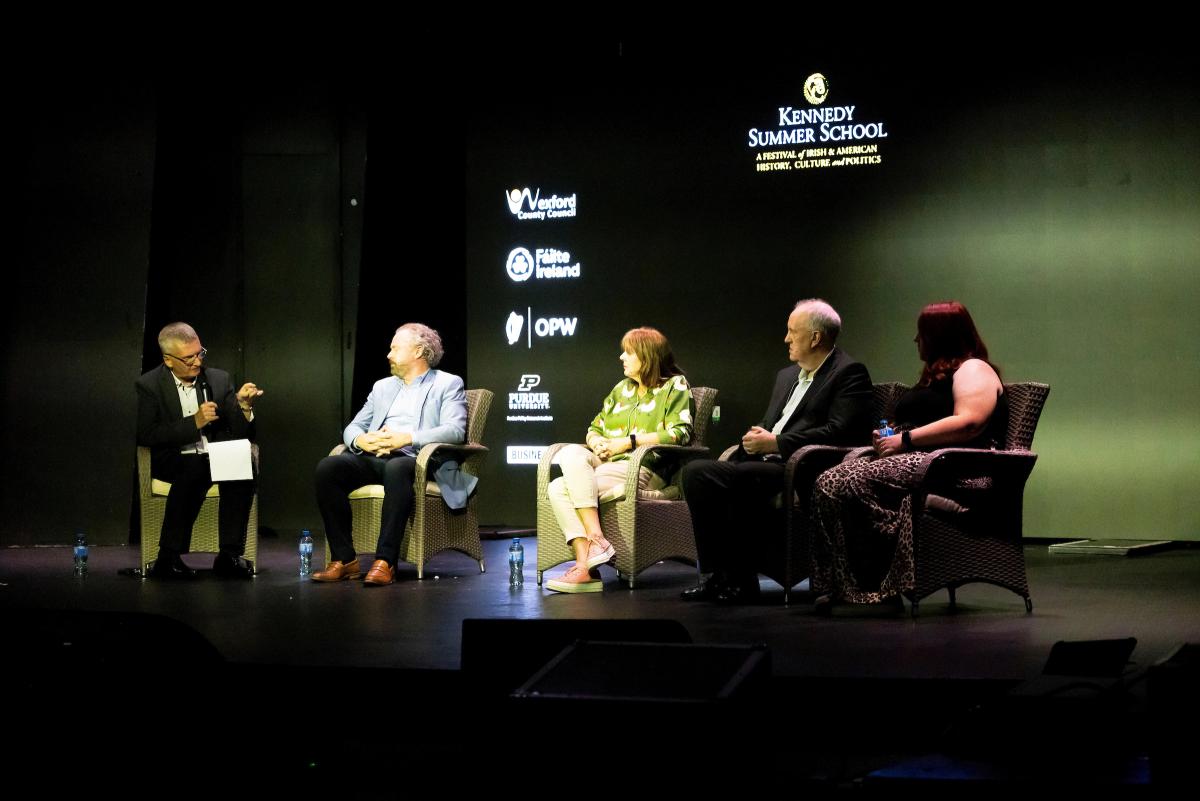
A panel discussion on journalism on both sides of the Atlantic featured, from left, Alan Corcoran, Bill Forry, Brenda Power, Dave O’Connell, and Jessica O’Connor. Mary Browne photo
The Irish have their own domestic politics to ponder. But it’s our president — and his chaotic approach to governing and statecraft— that was the dominant topic. The Irish are deeply concerned about Trump’s to-date futile attempts to curb Vladimir Putin’s aggression in Ukraine. They are also disgusted by Israel’s war on Gazans that continues to escalate with no credible sign of US intervention.
Like their far-flung cousins here in Dorchester, the Irish aren’t monolithic in their thinking or in their politics. They boast several political parties and as many opinions as there are sheep in the fields. But there’s large consensus there that Trump’s America is an unreliable, even menacing, force that is lurching into a full-blown totalitarian regime, to the detriment of the world, themselves included.
Like many of us here, they largely think we’ve lost our minds and moral compass as a world power. It’s hard to argue the point.
A rare bright spot of the week’s visit was the work of Mark Daly, an elected member of Ireland’s Senate who is working to re-imagine and reconstitute the Irish American “lobby” in the States by bringing lawmakers with Irish roots— or constituencies— to Ireland for visits, both north and south.
He makes the case that the Irish have to do a better job convincing US lawmakers— at the state and local level— that just as the Irish needed their cousins to assist in the 1910s or 1990s, they are once again being called on to remember their roots— and to act accordingly. Perhaps it’s time for Americans with ties to Ireland to start tuning in a bit more closely to their cousins’ critiques.
Bill Forry is the executive editor and co-publisher of the Dorchester Reporter. He also contributes to BostonIrish.com.
