

By Lucas De Oliveira, Special to The Reporter
Through a post on the now-defunct Yahoo Personals dating site back in 2007, Elisa Girard found Vivian Girard, a French general contractor with a passion for sustainable building – an irresistible combination for a self-described Francophile and sustainability nerd. Eventually, they’d become partners in both life and business.
They say it’s been easy to balance work and love. They’ve renovated condos together, co-founded Fields Corner’s home.stead bakery & café and just recently finished their four-year development on a 14-unit micro-apartment building in the same area.
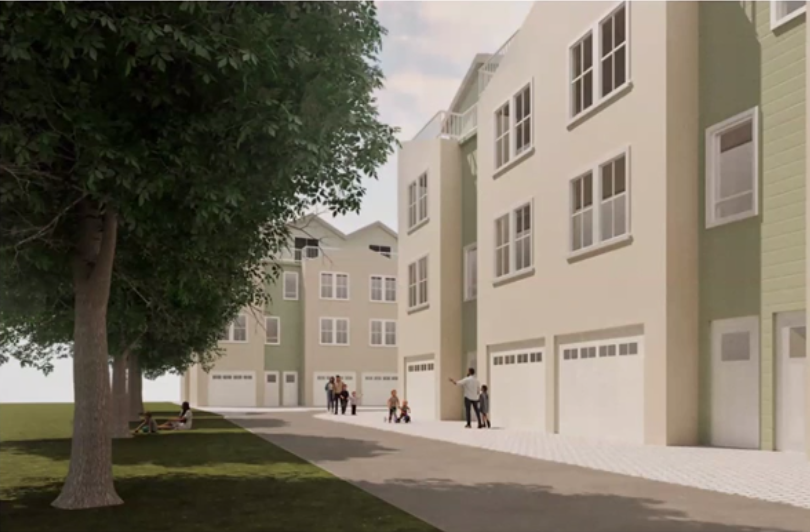
The units are studio apartments with walk-in closets, bathrooms, and kitchens. They’re small—around 280 square feet—but they do the job. And what was once an empty lot with dead, ratty grass is now a four-story, contemporary, cube-like structure sitting at the end of Westville St.

And the rent? $750 to $870 a month. In an area where rent for a studio apartment stands at $1,437, the lower numbers make all the difference.
Vivian considered how employees at home.stead had to drive from outside the city to get to work because they didn’t want to break the bank on an apartment in the area. “Employees in the service industry, after taxes, make three grand a month,” he said. “You don’t get anywhere around here for that kind of money.”
Says Rachel Spekman, a longtime friend and neighbor of the Girards, “What they’re aiming to create is really a new way of living. They’re recreating the idea of housing in Boston from the ground up.”
The project was a labor of love, with the two taking active parts in some of the construction and design. “I would have given up on so many problems along the process,” Elisa said, rocking a copper-colored bob in a neon green jacket, looking over to Vivian, as we sat inside home.stead, “and he just keeps going, he just figures it out, he does it.”
Vivian, in matching athletic shorts and shirt, chimed in, looking ahead and then a glance at Elisa, “She doesn’t give up on things I would give up on. It’s complementary.”
Vivian said he is more “mechanically and structurally inclined,” handling the handiwork of their projects, while Elisa takes on the task of beautification. They recently started adding fencing in the back of the micro-units. “I kind of have an idea of how it will be,” Elisa said, “and then he makes it better than my idea.”
Like most modern love stories, theirs started with an online message, one sent by Elisa that turned into a first date at Diesel Café in Somerville’s Davis Square.
Elisa’s first impression of him was immediate ease—easy conversation, and easy to be with. After lunch in the middle of the gas station relics of the café, they walked down the Minuteman Commuter Bikeway in Davis Square, talking about their lives, families ,and passions.
Vivian soon showed Elisa one of his passions, a renovated six-family home he’d purchased in Dorchester with his ex-wife, whom he’d later bought out of the property. She thought a second date at that home was strange, but she’d never experienced Dorchester and could tell he was proud of the project.
In their first year of dating, Elisa was introduced to building renovation when she and Vivian tiled the bathroom of the six-family. They moved into a condo in the same building in June of 2008 and have lived there ever since.
After a series of dates in quick succession over the course of a month, Vivian told Elisa he wasn’t interested in seeing anyone else. She paused and said she had to give it some thought.
“I didn’t sleep that night,” Elisa said, “and the next day, I told him I wasn’t going to date anyone else.”

Elisa and Vivian Girard sit on a church pew inside the home.stead bakery & café with wording behind them that offer their approach to life. Photo by Lucas De Oliveira
Nine months later, the two had a conversation about marriage. Vivian had already casually told Elisa that he could see a future with her. She had two weeks off coming up, and a thought: I’ll ask him not now? “Sure, that sounds good,” he replied. “Are we engaged?” she asked. “I guess so,” he answered.
After two wedding ceremonies—one in the James P. Kelleher Rose Garden in Fenway for close friends and another in Wisconsin for Elisa’s family—and no honeymoon, the two set off to live the rest of their lives.
Seventeen years later, Elisa, now 50, and Vivian, 54, walked into home.stead on a recent Saturday morning and sat down on the repurposed church pew they bought off Craigslist in 2015. “I’d always had a dream of a café,” Elisa said, “but I never pursued it at all; it wasn’t on my radar.”
She said she’s always admired café culture and once created a mock-up café called “The Lime Tree Café” for her senior show in college, which she said was the “little spark” that ignited the dream of owning one someday.
In 2014, Jack Wu—who at the time worked as chief financial officer for College Bound Dorchester, but was looking to start his own business—tried Elisa’s French casserole and sourdough bread and said they should work on a café together.
He scouted for locations and found one at 1448 Dorchester Ave. The idea was to open sometime in 2015, but the project took longer than anticipated and officially opened in March of 2016.
“We had a handful of friends come and help take out all the piles of junk, and load up the dumpster on the side,” Elisa said. “It was mostly Vivian and I who renovated the space, and we uncovered some of the brick walls and changed the layout of the stairs.”
The original terrazzo floors from its pharmacy days remained, along with the video store layout—complete with a backroom once reserved for X-rated films. Aside from some of the artwork on the walls and new tables by the sides of the café, little has changed in its nine years of operation. If anything, it’s only gotten cozier.
The glass chandeliers still hang over the center of the café, as do the string lights by the windows to the side and front of the space. The fridge, espresso machine, and center dining table haven’t moved an inch either.
As the pandemic impacted eateries all over Boston, the idea of selling loomed in their minds. home.stead had closed and not shifted to takeout like most restaurants. “That wasn’t the idea of this place,” Vivian said. But none of the buying offers they received were serious bites. Wu would tell them that if they were going to give it away, it would be better for him to buy them out.
“Vivian already had the plan for [the micro-units] in the works, so we could see it coming together,” Elisa said. “So we thought that it was a good time to step back.”
And step back they did.
In 2018, Boston launched the “Compact Living” pilot. The development saw the city encouraging the construction of smaller units, offering more affordable living for Boston residents.
The Girards’ project is one of the many to come from that pilot. They contacted Marcy Ostberg, the former director of Boston’s Housing Innovation Lab—the group that led the pilot program—to get involved.
It took a year and a half for the design and permitting process, and another four years for construction. The development cost the Girards $750,000. They used money from their interests in home.stead, a loan against another one of their properties, and salvaged materials from neighbors and the Boston Building Materials co-op.
Outside of having a company pour the foundation for the building and some contracting for plumbing and electrical work, they did much of the construction and design themselves.
When sitting in the lobby of the micro-units building, a visitor could tell it was a product of their handiwork, from the shade of white on the walls, the black leather couch that sat against the back of the area, to the collage art on the wall made by Elisa. It seems they didn’t need anyone’s input but their own.
“He had a vision for it,” Elisa said, “and we had never done it before. We just built the wall, and both lifted it together, screwed it into the ground, and then built another wall.”

Vivian and Elisa inside their Westville Street property. Seth Daniel photo
Outside interest in the project began almost immediately. Franklin Alcantara, a product receiver at Emerson College, tracked the progress of the building for three years before its completion. Every time he walked by the site, he stopped to ask Vivian when he could move in. He made sure the name Alcantara was at the top of the waitlist.
He left the Dominican Republic and arrived in the United States ten years ago and, until now, has only lived in shared apartments. For the rent he paid, he despised sharing a kitchen, bathroom, and general space with often loud roommates.
“I don’t know what happened here in the United States,” Alcantara said, “but the situation for living is terrible… It’s really expensive for a single room.”
When he moved into his unit on Sept. 1, he knew things were going to be different. The space is tiny, leaving little room to roam—just enough space for a queen bed, a small dining table with two chairs, and a compact kitchen with a mini-fridge. At the same time, it’s his own place. “I feel like a lucky man,” he said.
Alcantara thinks that buildings like this may be the solution to Boston’s housing crisis, but the Girards believe it’ll be hard to replicate their model in Boston because of a lack of cheap, suitable land and the presence of building regulations that could have developers spending a fortune to follow in their path.
The Girards had no choice but to follow the regulations in place, such as two stairwells and the installation of a sprinkler system for constructions above three floors. That said, with the amount they saved on construction, the costs balanced out.
Just like in their own lives, they weren’t burdened by any financial stressors from this project, which Vivian believes is the reason the partnership remained strong. He explained that they live modestly themselves, not breaking the bank on their own living situation.

Guests at a housewarming event checked out one of Vivian and Elisa Girard’s new units last June. Seth Daniel photo
“Vivian really wants to build affordable condos, which the city desperately needs,” Elisa said. “It’s just a matter of getting the land at this point, and it’s really, really expensive.” It’s not out of the question. Vivian said, noting that a smaller development is “up in the air.”
But with their housing project coming to its close, it’s a bittersweet time for the builders. “I loved every minute. I’m sad that we’re done. I want to do something else together at some point,” Elisa said, turning to Vivian.
“Cheap housing – that’s the key to everything,” he joked.
