

Anyone who has spent time hanging on a street corner in Dorchester remembers that the wise guy was respected as much as the pretty girl or the good athlete. Some of us who survived the rigors of the corner learned that laughter is an effective means of self-preservation. Humor was a weapon that could defang opposition and turn the crowd against rivals, and in this way, many Dorchester kids mastered the delicate art of repartee: the barbed quip; the stinging retort; the rhetorical put-down.
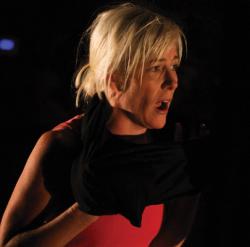 Sue Costello
Sue Costello is a Dorchester comedian who comes from this tradition. In performance, Sue covers the stage like a goalie in front of a hockey net, reinventing the calamitous events of her life and presenting them as a form of slapstick revue. Sue’s one-woman play, “I Wasn’t Trying to be Funny,” is a tell-all account that reveals secrets and settles old scores; she has been working on it for the last seventeen years. Sue says, “Tragedy + Time = Humor.”
In the late 1990’s, Sue spent time on the West Coast working in television, including her own show at Fox, “Costello,” which was quickly yanked off the air but not before providing her with the fifteen minutes of fame that launched her career. Today, Sue lives in Brooklyn, and is a fixture of the New York comedy scene. “I’m famous,” says Sue. “People recognize me because I’ve been on every TV show that’s ever been canceled. Or they think I work at Applebee’s. “
 Kyle Ploof: Kyle Ploof got his start at the old Emerald Isle.
Kyle Ploof (real name) is another comedian with Dorchester roots who has ground an axe and is ready to chop things down. His “You Tube” videos have titles like, “Worst Dad Ever!” and, “My Sister was the Favorite.” “Self-Checkout Machines” is a dissertation on the fringe ethics of modern-day grocery shopping.
Kyle got his start at the Emerald Isle in Fields Corner, and moved to New York after graduating from college in 2008. As a stand-up novice, he scraped his knees in New York, eventually realizing that he needed to step up his game, so he moved back to Boston for a couple of years to polish his act, before returning to knock ‘em dead in 2012.
“New York is the only place to live if you want a legitimate comedy career, but Boston is the best city,” he says, “because you can grow there while keeping off the radar. Professional comedians like to play Boston because it is a blue collar town that appreciates a good joke.” New York is more competitive, “You have to make yourself available for opportunities but it isn’t good to be seen too early.”
Back in Dorchester and living on Dot Ave., Bethany Van Delft is a former fashion model turned stand-up comic who is given to philosophical musing and mines the collective unconscious for contradictions that are the raw material of her art. Under the spotlight, Bethany remains poised and offers the jagged edges of her wit in finely wrought soliloquies that test the limits of propriety.
About being biracial: “I just say I’m black, because when I think about it, the only white thing that I do, really, is listen to hip hop.” And about becoming a mother: “We did not find out what we were having ahead of time, we wanted the sex to be a surprise, like the way she was conceived.”
Bethany feels that comedians have the most success connecting with the audience when talking about their own lives. But to make fun of something is more than just an easy way out. It takes courage to confront your fears; to do so in front of a room full of people is a demonstration of uncommon valor. People want to hear, and they are listening for something universal, some new way to laugh off the panic inside.
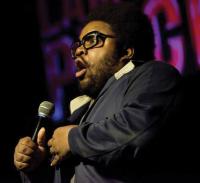 Lamont Price, OFD
One rising star is a young comedian from Codman Square named Lamont Price. Lamont is a tough guy with an imposing afro who isn’t afraid to admit that he is love-struck with Tom Brady. Lamont says that comedians are observers, first and foremost, who are able to pick up on the things that most of us miss. For example: “Why do hot dogs come in packs of ten but hot dog buns come in packs of eight?”
Lamont describes his laidback comic style as “controlled lunacy. Being funny is a natural ability for a lot of people, but being a comedian is a skill,” he says. “Among your friends it’s easy, because everyone knows what you are talking about. But if you are a comedian, you must make people relate to you who don’t know you, and don’t know each other, and then make them all relate at the same time to something that you thought of at three in the morning.”
John Florence Sullivan, the all-time most famous Dorchester comedian, is practically unknown locally today, even though he has two stars on Hollywood Boulevard’s Walk of Fame. He was raised on Grafton Street in what he knew as St. Margaret’s Parish, and took the stage name Fred Allen, starting out with vaudeville performances at the Strand Theater before going on to be one of the most popular humorists of the 1930s, 1940s, and early 1950s on radio and in early television. He died in 1956, at age 61, after collapsing on a New York City street while taking a midnight stroll.
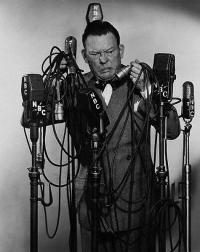 Fred Allen, OFD
Allen’s jokes were quick and clean – like this: “My wife cooked dinner and there were so many vegetables that we had to put a scarecrow on the table.” Allen did not mind being self-deprecating. Here is a story found on the internet: “After one of his appearances failed one day, Allen made the best of it by circulating an obituary of his act on black-bordered funeral stationery. He also mailed vials of his supposed flop sweat to newspapers as part of his comic self-promotion.”
Allen’s radio show, “Town Hall Tonight” was the longest-running hour-long comedy-based show in classic radio history. In his autobiography, “Treadmill to Oblivion,” Allen wrote about how the sound effects and voices of a radio show are interpreted differently by every individual listener, allowing people to take imaginative flights of fancy, whereas television is dismally limiting, because everybody’s viewpoint is fixed on the same image. For Allen, who was a panelist on television’s ‘What’s My Line” show at the time of his death, TV was the death of the imagination.
Fred Allen would no doubt be speechless if he could see the new ways in which comedians operate today, especially through social media. One thing that hasn’t changed over the years is the flavor of Boston humor: smart with a snappy attitude. Being from Boston does carry an added bit of comic cache. According to Kyle Ploof, people who live in other parts of the US think that our accent sounds hilarious. Now that’s funny.
•••
Sue Costello will be headlining at “the “Women in Comedy” Festival in April and with “Laugh Boston” in June (SueCostello.com). Kyle Ploof, a regular on “Last Week Tonight with John Oliver” on HBO, appeared as a talking head on MTV’s “Best Music Moments of 2013” (kyleploof.com).. Bethany Van Delft is a force in “MOTH Story Slam” at Oberon; and hosts “Artisanal Comedy” every fourth Wednesday of the month at Savin Kitchen and Bar (bethanyvandelft.com). Lamont Price closes a longstanding run at the Sweetwater Tavern on March 19 with his show, “The Last Temptation of Price.” Follow him on Twitter and watch for him on ESPN, Comedy Central, and Sirius XM(lamontpricelive.com).
