


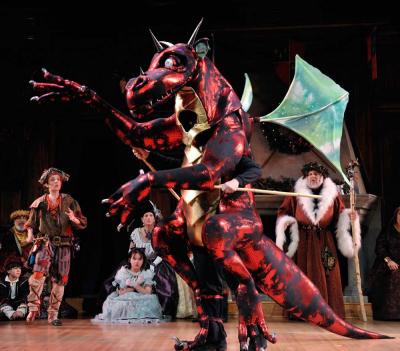
 A scene from the Christmas Revels features the Dragon Nigel. Roger Ide photo
Dragons and choral singing are just two of the attributes that the Christmas Revels shares with the mystical, mysterious land of Wales.
It has taken 45 years for the Revels, that never-visit-anyplace-twice Winter solstice pageant at Sanders Theatre, to stage a sort of Yuletide eisteddfod [festival]. These uniquely Welsh productions of literature, music, and performance bear out Wales’s right to call itself “the land of song” and also suggest why this culture fits so well into the Revels format.
Just as Wales is a realm of co-existing opposites, Revels gains much of its power – some would say “magic”– by transporting audiences to a sort of crossroads of epochs and values.
Revels salutes the dying of each old year and hails the arrival of each new one. While surveying Welsh history, this Revels gently throbs with an additional personal poignancy. This production is the last one to be co-created and orchestrated by masterful Music Director George Emlen, who is of Welsh descent. So this triumphant farewell seems more heartfelt and consequential than many of the previous 44 editions.
A quick glance at the program book may confirm one’s fears as the titles of the songs appear in notoriously impenetrable Welsh. But at the top of the show, song master David Coffin reassures audiences that the sing-a-longs (a Revels hallmark) will not require mastering a single word of Welsh.
Strange as the spellings are, it soon becomes apparent that the tunes, if not the lyrics, are quite familiar.
“Ar Hyd Y Nos” is the world-famous lullaby “All Through the Night.” Churchgoers will recognize that the Welsh hymn “Hyfrydol” has had its melody “borrowed” for many English songs of worship. And after all, where did we learn to “Deck the Halls” but from “Nos Galan”?
Then, too, longtime Revels poet/consultant Susan Cooper (a Welsh ex-pat herself) has translated traditional lyrics into easy to sing English. She also rewrote the Mummers’ Play (always an Act II rib-tickler), giving it contemporary resonance.
In her version , St. George makes way for St. David as the hero, and the representative of dear old Blighty finds his hands full trying to put Welsh and Irish upstarts in their place. This is the section in which the fierce red dragon seems to leap off the Welsh flag and make mincemeat of the British overlords – to the uproarious approval of the spectators.
Cooper collaborated with Artistic Director Paddy Swanson in molding the script. They borrowed scenes from Dylan Thomass’ “A Child’s Christmas in Wales” and used the ancient myth of the birth of the bard Taliesin, a wild saga of shape-shifting magic, to do some delightful and dazzling Story Theater-style entertaining.
Much of the comedy of the evening is sold by the irrepressible Billy Meleady, who has brightened a string of recent Revels. Jeremy Barnett’s village set topped by lowering gray clouds complements the many subtle shades of Heidi A. Hermiller’s costumes.
The bittersweet, last hurrah feeling (which this time pays tribute to the departing maestro) permeates every edition of the Christmas Revels to one degree or another. No wonder so many people make it their own year-end tradition.
Performances continue at Sanders Theatre in Harvard Square through Dec. 27.
