



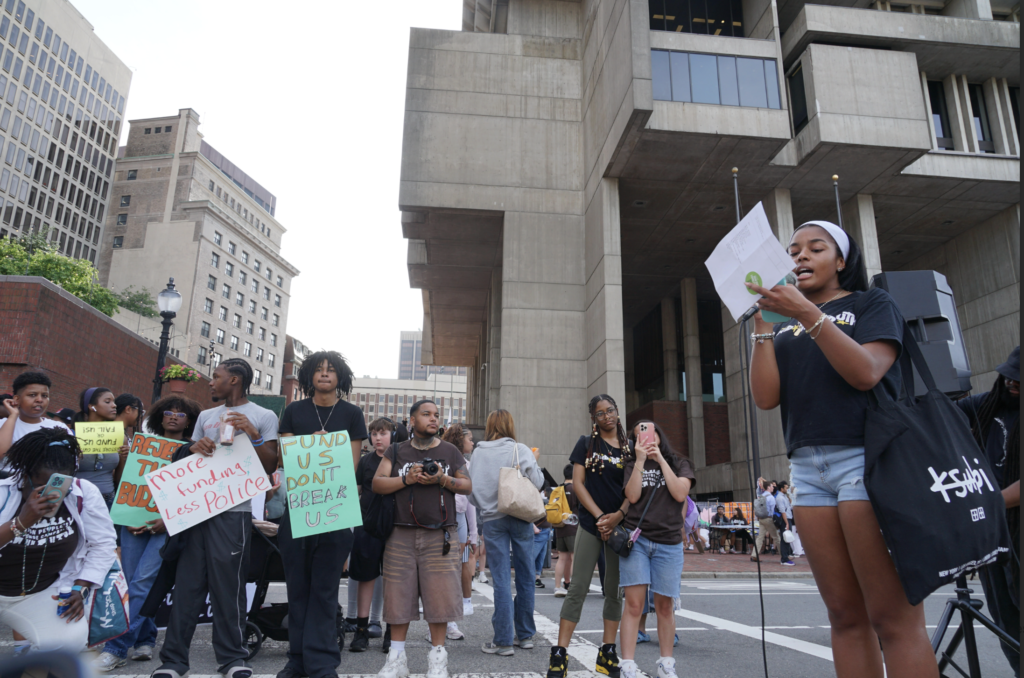
Above: Ella Simone, an activist with the Youth Justice and Power Union, rallies demonstrators outside City Hall during a May 26 protest. Yawu Miller photo
On June 3, when a vote was scheduled on the city’s operating budget for FY27, the chair of the City Council Ways and Means Committee, Ben Weber, asked for a 15-minute recess. Five days later, after more revisions to their spending plan, Weber and his colleagues were struggling to reach enough consensus for a seven-vote majority—while under a late-breaking cloud over budget ethics.
At the council’s virtual working session on Monday, June 8, Weber proposed $8.2 million in budget amendments, sidelining a $1.2 million restoration previously earmarked for the Mayor’s Office of Immigrant Advancement (MOIA). Weber announced that he would abstain from acting on MOIA funding in deliberations over the amendment package, because his wife, Alexandra Weber, works for the International Institute of New England (IINE), a nonprofit that has received grants from the agency in past years.
Early in the session, Weber noted that this year’s sum of changes by the council was greater than the amounts that finally were approved in the last two fiscal years. As a result of changes approved by Boston voters in 2021, the City Council has the power to increase spending for individual budget items, but not to exceed the total spending proposed by the mayor—barring updated revenue information. Increases by the council have to be offset by subtractions—or “pulls”—from other items.
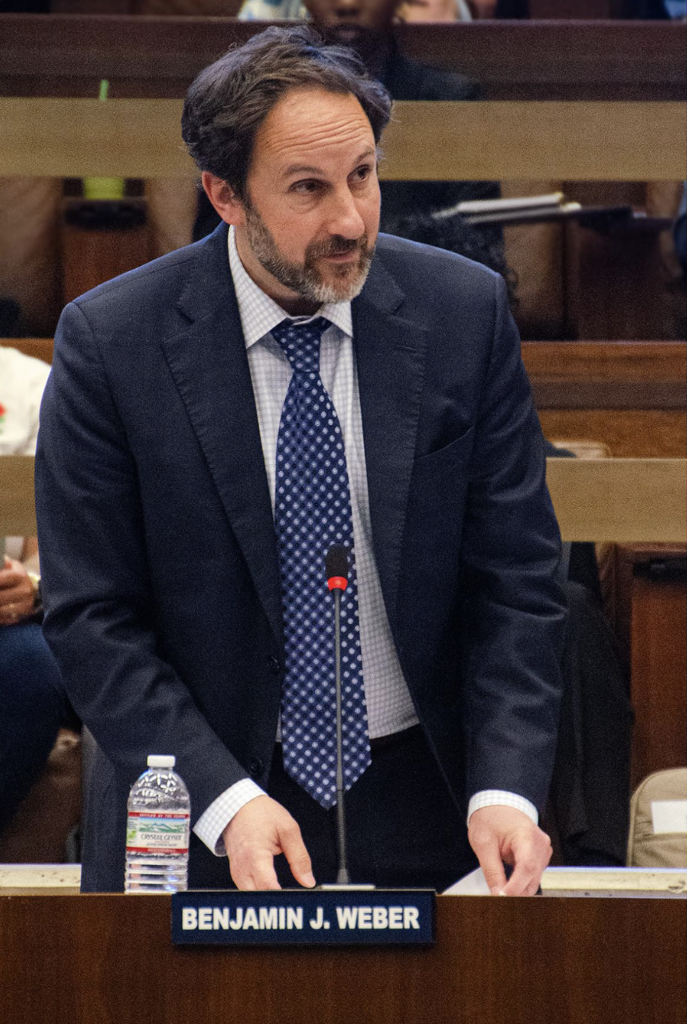
Councillor Ben Weber during a budget session last week in council chambers. Chris Lovett photo
“I do think the most productive area of discussion,” Weber advised early in the session, “is if there are areas in these increases that we want to change, then I think, in terms of the work that we’ve done on where the pulls are coming from, (if there are) any increases in those amounts there’s serious risks of forcing layoffs or impacting vital services.”
Shortly before the session, councillors received a similar message from Mayor Michelle Wu’s chief financial officer and collector-treasurer, Ashley Groffenberger. Though not citing Weber’s proposed amendment package, Groffenberger warned against pulls that were being advocated by “various” councillors.
“Many of the Council’s proposed reductions would remove resources from departments that have already been asked to absorb substantial budget adjustments, including increased salary savings targets and other reductions in funding from FY26 to FY27, and we specify the operational consequences of further reductions below,” Groffenberger wrote.
She went on to add that “additional staffing reductions would constrain the City’s operational capacity and diminish our ability to meet the needs of residents, directly affecting the level, quality, and responsiveness of services that residents expect and deserve from city government.
In some cases, these proposed cuts would impact the City’s ability to collect fines, fees, and other payments, which will ultimately reduce revenues at the same time services are reduced.”
Even in Weber’s package, a pull of about $3 million from the Boston Police Dept. budget—roughly half of it for overtime—was opposed by some of his colleagues. Though Councillor At-Large Julia Mejia said she could agree with the pull, she suggested that the money could be reallocated differently.
Weber scaled back his committee’s amendment package after Wu’s June 1 announcement of a new “public-private coalition” for “expansion and redesign of school-year learn-and-earn opportunities for Boston students.” As described in the mayor’s press release, the coalition would “work to provide 2,000 job opportunities for Boston students ages 14-18, connecting them to part-time, career-connected jobs with private employers, community-based organizations, and local businesses.”
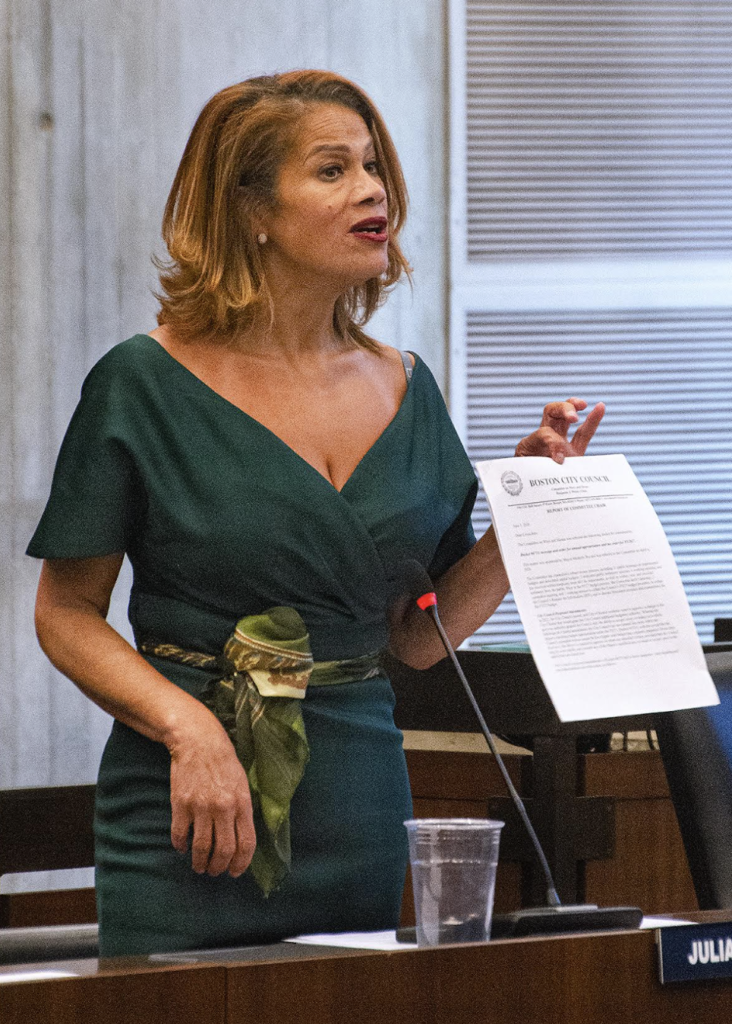
Councillor-at-Large Julia Mejia. Chris Lovett photo
Mejia has argued that the initiative would mean fewer jobs with community-based nonprofits, and she questioned whether the goal of 2,000 jobs would be reached—or maintained in the coming years. Also raising the issue of nonprofit placements was District 7 (Roxbury) Councillor Miniard Culpepper.
Councillor At-Large Erin Murphy and District 2 (South Boston/South End/Chinatown) Councillor Ed Flynn told Weber that they wanted to offer additional amendments—with specified “pulls”—at the council meeting scheduled for June 10. District 3 (Dorchester) Councillor John FitzGerald mentioned his own plan to seek $200,000 for the “coordinated response team” to address problems related to substance use disorder, even beyond the area of Massachusetts Ave. and Melnea Cass Boulevard.
“I still think there’s more money out there to pull from, to restore some of these cuts and maybe add to some of the amendments that myself and other councillors might have that did not make it into this package,” FitzGerald said, “so I will continue to work on those amendments with my colleagues.”
FitzGerald had suggested $5-7 million in alternative “pulls” at the council’s working session on June 1. But, at the June 8 session, he also acknowledged that this year’s spending limits were tighter than in previous budget cycles.
“Even if it’s just a couple of percentage points higher for everything, I think there’s a way to get these numbers to tick up. We’re at the end of the day in a tough budget cycle,” he said. “You know, we’re not going to have the greatest story to tell, but no one has a great story to tell this year. But we’ll have a story that says we did the best we could to get everyone back to the status quo.”
To make decisions about pulls, Weber reminded councillors, had to rely on information from the mayor’s administration, while expecting “rough waters” in the future.
“I think it’s like the debate is between what we can do and what we should do,” he said. “and there might be more money, but in the way the budget is, it looks this year with a $70 million deficit and revenue projections, like kind of a reason to get back to just an even budget. And then, with these trends continuing next year, we tried to not push the envelope into places where we’re sort of assuming everything else is going to work out.”
Weber’s decision about MOIA spending followed a complaint with the State Ethics Commission that was filed by John Smith-St. Cyere, the founder and executive director of the J.L. Smith Suicide Prevention Center for Young Black Boys, Inc. He was among the speakers who joined Councillors Mejia, Culpepper and Murphy in raising concerns about the budget in an April 15 press conference.
In her promotion of the “tax day” press conference on Instagram, Mejia summed up its message as “No taxation without representation.” In March, Smith-St. Cyere was also among the speakers voicing opposition to Wu’s plans for renovation of White Stadium, under a public-private collaboration with Boston Unity Soccer Partners.
At the start of the working session, Weber said he had previously been told by city and state officials that, as a councillor and later as committee chair, he would not incur a conflict of interest, since the organization where his wife works, the International Institute of New England, receives funding through a procurement process, rather than through a direct earmark by the City Council.
“When I wanted to become a Ways and Means Chair,” he said, “I again called the State Ethics Commission and was told the same thing, and I reached out to (the city’s) corporation counsel and was told that this is not an issue. Having spoken again recently to the State Ethics Commission, because we’ve had such a strong focus on restoring the cuts and, I think, out of an abundance of caution, I’m removing any funding from MOIA in the amendment package that I’m putting forward.”
As of Tuesday afternoon, this reporter did not receive a reply from Weber to an email request for a more direct representation of ethics guidance.
Weber was among the councilors more closely aligned with the mayor voting last month against a motion by District 4 (Dorchester/Mattapan) Councillor Brian Worrell to reject the mayor’s budget. The vote was 6-6, with the motion falling one vote short of the majority needed to carry.
Weber said Monday that he could still vote on an amended budget in its entirety. According to the city’s corporation counsel, Michael Firestone, if the council fails to take definite action on the budget by the second Wednesday in June, the budget originally proposed by the mayor in April would automatically take effect.
