

Over his eight years at Neighborhood House Charter School (NHCS), Scott Urban has attained “legend” status for many with his work as a physical education specialist and athletic director. Last month, that status was enhanced when he was named District 6 Athletic Director of the Year by the Massachusetts Secondary Schools Athletic Directors Association (MSSADA).
MSSADA is dedicated to training and supporting high school athletic directors across Massachusetts, which the organization has divided into 9 districts. Each year a director from each one is recognized for his or her leadership, integrity, and impact.
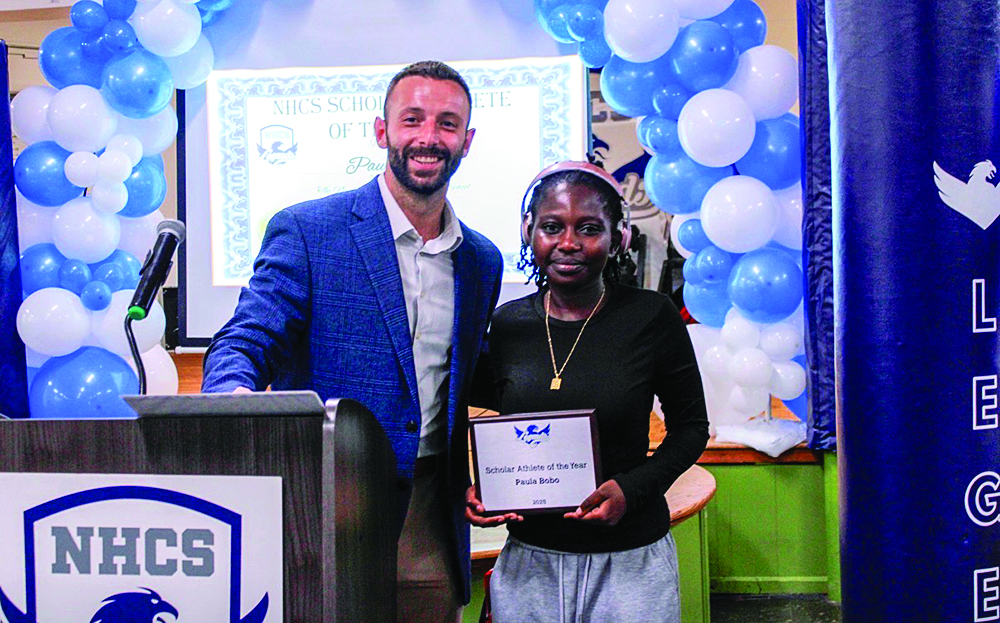
This year it was Urban’s turn in District 6, which the 34-year-old called “very diverse. By comparison with other districts, all those schools are very similar in their demographics, who they serve, where they’re located, all that stuff. District 6 has all of Boston, a lot of the South Shore, and north of Boston.
“You have super inner city, and then you also have your private schools like your Xaverians, Catholic Memorials, Arlington Catholics, BC High; all those schools are in our district,” he noted. “Those are some of the heaviest-hitting, high-powered offenses in the state in regard to athletics. When you think of high school athletics in Massachusetts, you think of BC High; you think of Xaverian. With those guys being in our district [and me being at] a small charter school, I’m not thinking that I’m ever going to win this award, right?”
Wrong. But the title didn’t come overnight. Urban got his start at the public alternative school in Dorchester back in 2018. When he applied for an assistant teaching role, he was advised to look into an open physical education position.
“I didn’t know, but baked into that job description and role was that you’re going to be athletic director, too,” explained the western Mass. native. “That is how it all ended up happening. It was very much the right place at the right time.”
Athletics weren’t anything new to Urban; in fact, his family jokes that his first steps as a toddler were straight to a baseball field. His childhood activity included an array of rec sports, but his big three in high school were soccer, indoor track, and, of course, baseball.
From kindergarten to senior year, his time spent on field and track shaped his identity and positively impacted his life in and outside of the classroom. When he signed on at NHCS – where there was no athletic department – he knew that could be the case for his students, too.
“There was no requirement to be an AD as far as the description went. They wanted a warm body,” the Dorchester resident said jokingly.
But he quickly proved that the school got more than that with his hiring. “That first year I came on, we added boy’s soccer in the fall, cross country, and girl’s volleyball. I kind of got thrown into the fire.” By winter, he had introduced boys’ and girls’ basketball and a cheer team, and with spring came baseball and track and field. Next were football and softball, but the most recent additions are middle school flag football and girls’ varsity flag football.
“We’ve grown now to have all of those offerings plus more. We’ve got sub-varsity offerings now,” said Urban, who is also the director of operations for the Massachusetts Charter School Athletic Organization. “We got JVs, middle school, and freshman teams. We’re organization-wide now. We’re K1-12, and we’ve got a fully fleshed out middle school athletic program and, obviously, our high school athletic program.”
His longtime friend and NHCS colleague Jack DeChristopher, director of student services, says that what Urban has built over the years will last. “Scott’s years of grindstone efforts will have lasting impacts on this organization and those we serve,” he said. “The infrastructure he’s developed has dramatically increased access and opportunity for middle and high school students year-round.”
DeChristopher, also the assistant varsity basketball coach, added, “What stands out most about Scott’s work is his ability to create systems that sustain growth while maintaining a strong focus on student development and programmatic integrity. Scott approaches athletics as an extension of the educational mission of the school.”
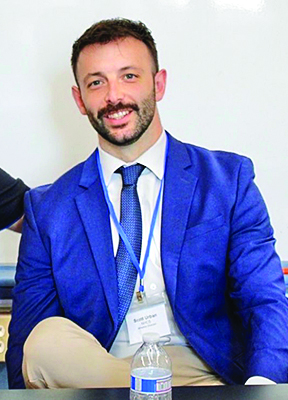
For his part, Urban sees athletics as a continuation of NHCS’s mission because he knows that for many students, it’s “knowing how important sports are, what the opportunities are and what being a part of a team means and looks like as you progress through life. That’s really why I show up and come to work every day.”
Through their sports activities, his students learn what it means to be competitive and how important it is to show up on time, meet deadlines, and work together toward a common goal.
Along the way, Urban has learned some lessons, too. He noted that “early on, we didn’t necessarily have the budget to accommodate how excited I was feeling about starting all these things,” but that that was just part of his “learning experience.”
In addition to managing a budget, he had to master organizing all his teams’ schedules and permit requests for practice times and gamedays.
He said the hardest part has been one that many charter schools in the city face: limited resources. “There are so many people living in Boston, and the way the space is allocated, there is no room to have your own gym. We don’t have our own gym on site; we don’t have any athletic facilities. That’s one of my biggest hurdles, making sure that I can secure a suitable space to accommodate a sanctioned MIAA game. Then there’s making sure that I can flesh out a full schedule for my kids because they deserve it, too.”
He added, “We have got to dish out quite a bit of money just to have courts. My middle school basketball team practices at a different court every night because I have to juggle all of our spaces between all of our teams and create schedules. Navigating that is probably the most difficult part of the job.”
But somehow, his head down, Urban gets it done.
“Scott consistently works behind the scenes to ensure everything runs smoothly, allowing coaches to focus on developing our athletes and building successful programs,” said varsity boys basketball coach Kat Walker. “He supports every sport equally, values coaches’ input, and fosters an environment where feedback is welcomed and respected.
“From day one, he has been an incredible leader and an unwavering source of support for our coaches, student-athletes, and their families,” continued Walker. “Simply put, we wouldn’t be able to do what we do without an outstanding athletic director like Scott.”
One of Urban’s proudest moments happened last year when every NHCS varsity team made it to the MIAA State Tournament.
“I think that’s, for any school, a very difficult thing to do because of the nature of high school athletics,” he said. “There are so many ebbs and flows. What that did to the school culture and the school athletic culture, everybody was excited to be part of the team; no one was embarrassed to go and take the field. Everyone was really bought into what it meant to be ‘a legend.’ That was really cool to see.”
Urban wants to keep all that going. His next priority is building continuity between the middle school and high school programs. “That’s the big agenda item,” he said. “Making sure coaches from middle and high school are communicating. Creating opportunities for those students to mingle together, which in turn should allow for more retention from 8th grade to 9th grade.”
“We didn’t have a high school before I came in, so culturally they all came through K1- 8 and then went off to testing schools. A lot of the families are bought into BPS and being part of the testing schools. We’re trying to flip the script and keep kids around and show that we can offer the same things, at least from an athletic perspective.”
Those who do stick around until graduation always find their way back. “Our alumni want to be around. They love to come back, and it’s great to see them. I have alumni coaching now. They come to visit, and we see them at the games often. Whenever they are home on break, they will come through.”
Like his former student-athletes, Urban says, “I keep coming back here, because, first of all, the kids, but secondly, the people I work with. That’s the coaches, admin, and teachers. Every year, I probably say, maybe I should look at other opportunities, but I continue to come back here, and I think that speaks a lot to the organization and the people in it.”
